
Product Management today has evolved tremendously over the years. What began as a niche role at companies like Hewlett Packard during the early days of Silicon Valley in the 1980s and 90s has since become a highly visible and sought-after position among many aspiring tech workers. For me, it has taken a long time and a lot of hard work to not only gain the skills and know-how to succeed in the job but also to build the confidence and faith in myself that I truly belong in this field.
For someone who graduated in 2007 with a bachelor’s degree in the humanities, my path felt quite different from the typical computer science or engineering backgrounds of many product managers, even today. At the time, I was far more interested in language, culture, the arts, and history than in the happenings of Silicon Valley or the who’s who of the next billion-dollar company. However, as major tech giants like Twitter and YouTube were just starting to take off, I found myself increasingly interested in how modern technology could intersect with the natural world around me.
My love of the outdoors, particularly birdwatching in places like the Presidio and Golden Gate Park in San Francisco, soon merged with a growing interest in product management. After a few years working at the startup One Kings Lane, I eventually took the leap to start my own company, Blubyrd, with the goal of building a digital app for fellow nature enthusiasts. This unique blend of my liberal arts background and environmental passions has continued to shape my unconventional approach to product work over the past 10+ years.
For the sake of this post, I’ll share some of the key lessons I’ve learned—from navigating ambiguity and aligning cross-functional teams to challenging common product management dogma and discovering the power of mindfulness. By highlighting my perspectives on the subject, I hope to encourage other PMs to adopt a more strategic, customer-centric, and self-aware mindset.
Navigating Uncertainty & Aligning Teams

Like any job, product management involves a fair amount of ambiguity. As the link between various functional teams—from sales and marketing to engineering and customer service—a significant part of the role is finding the right answers to the right questions that everyone can agree on.
The challenge is that companies can be either “data-rich” or “data-poor.” Some organizations are drowning in metrics and analytics, while others lack the necessary quantitative and qualitative insights to make informed decisions. My approach has been to ground myself in a few key metrics available to me. For quantitative insights, this might mean analyzing any type of user interaction with your product—whether that’s daily active users, webpage visits, or NPS scores. For qualitative insights, conducting customer interviews, surveys, and gathering anecdotal insights are very useful to have on hand at all times.
The key is correlating these data points back to high-level business objectives and the overall mission of the company and product. Knowing why your organization and your specific offering exist in the first place is crucial for distilling priorities and aligning cross-functional collaboration.
One framework that has been particularly helpful for me in this regard comes from Stephen Covey’s book The 7 Habits of Highly Effective People. The third habit, “Put First Things First“, emphasizes focusing on strategic, mission-driven initiatives rather than just getting caught up in routine processes and meetings.
For example, when I was working as a product manager at Robert Half, we had a robust data and analytics infrastructure that sometimes felt overwhelming. By applying the “First Things First” principle, I was able to focus on the metrics that were truly indicative of our broader objectives, such as customer acquisition cost and lifetime value. This allowed me to have more meaningful conversations with stakeholders and make better-informed decisions about our product roadmap.
Conversely, during my time at Delta Dental, we faced the opposite challenge of being “data-poor.” In that environment, I had to be more proactive about gathering qualitative insights through customer interviews and user testing. I worked closely with the design and research teams to map out detailed user flows and uncover pain points that the data alone wasn’t surfacing. This helped us build a stronger business case for the product enhancements we wanted to prioritize.
Challenging Product Management Dogma

While having systems and processes in place can be valuable, I’ve found that they can also be detrimental if applied too rigidly. A prime example is the ubiquitous one-on-one meeting.
In my experience, these regularly scheduled check-ins can sometimes feel more like hurdles to overcome than genuine opportunities for collaboration and feedback. If the meetings don’t foster authentic dialogue and mutual understanding, they risk becoming a box to tick rather than a meaningful interaction.
Instead, I advocate for more organic, just-in-time communication, whether that’s via quick email updates, one-page status reports, or—if in person—casual hallway conversations, or—if remote—quick Teams/Slack updates. The goal is to find an approach that works best for your specific team dynamic and individual preferences.
SPEAK UP!
At the same time, I’ve learned the importance of speaking up early and often, even if you’re not 100% sure your ideas are on the mark. Having the courage to voice your perspective—and backing it up with the aforementioned data points—is crucial for establishing yourself as a credible and influential product manager, especially in the first 90 days on the job.
Early in my career, I was often hesitant to share my thoughts, worried that I might be wrong or appear inexperienced. However, I’ve found that making your voice heard, even imperfectly, is ultimately better than staying silent. It demonstrates your passion, builds trust with your teammates, and gives you the opportunity to learn and iterate.
The Art of CONDUCTING VALUABLE Discovery
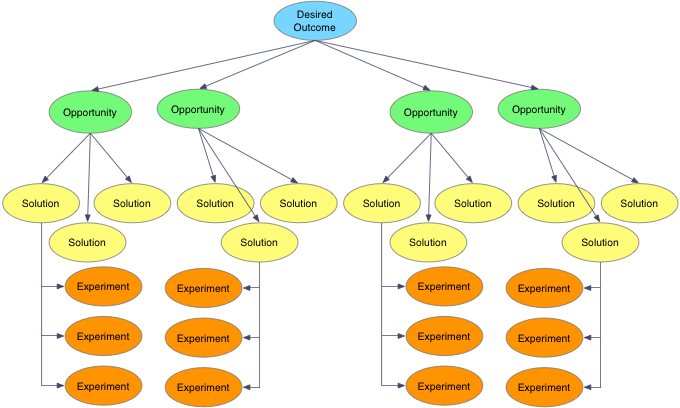
While product managers need to be well-rounded, I’ve found that leveraging your unique strengths is often more impactful than trying to shore up your weaknesses. For me, the area I’m most passionate about and excel at is the discovery phase.
I love immersing myself in the customer experience, conducting interviews, and mapping out user flows with my design and engineering counterparts. Tools like opportunity solution trees and collaborative diagramming sessions help bring diverse perspectives together and uncover valuable insights.
One specific example comes from my time at Delta Dental, where I worked closely with our UX designer and lead engineer to diagram the ideal end-to-end flow of looking up and validating a patient’s benefits against a specific treatment a dentist was performing. By walking through the various touchpoints—from account creation to cataloging sightings—we were able to identify several friction points and potential enhancements that our initial product vision had overlooked.
BUILDING A Long-Term Strategy Around Your Discovery
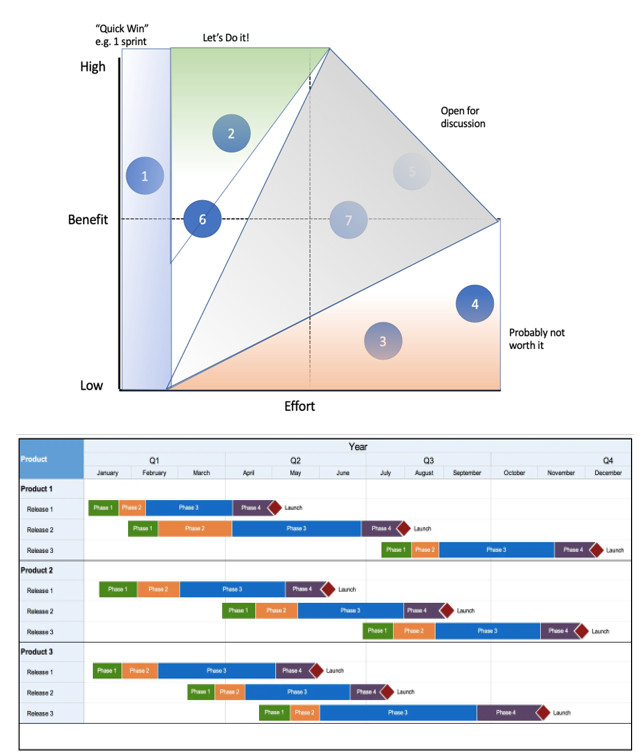
Discovery work ultimately lays the foundation for product roadmap and strategy. Of course, the next step is translating those learnings into long-term plans that communicate the current state, future vision, and tangible steps to get there. Simple templates like value vs. effort matrices can be highly effective for aligning stakeholders on what to work on first. The matrix is structured with “value” on the vertical axis and “effort” on the horizontal. This allows you to clearly identify the “quick wins” as well as the more complex, strategic bets that would require buy-in and coordination across the organization.
Ultimately, the beauty of this framework was its simplicity and accessibility. Rather than getting bogged down in Gantt charts and technical roadmaps, we had transparent, high-level conversations about where to focus our energy. This proved invaluable for aligning the executive team, engineering, and customer-facing groups around a shared product vision.
Facing Setbacks & What to Do

I could probably teach a master class in failure as a product manager, but my entrepreneurial experience with Blubyrd has been particularly formative. As a 28-year-old who thought I could build a successful birdwatching app based on my personal passions, I quickly learned some hard lessons.
Namely, I failed to do proper market research, competitive analysis, and industry landscape evaluation. I had been so enamored with the prospect of bridging my love of nature and technology that I assumed my intimate knowledge of birdwatching would translate directly to building a viable product. But I was sorely mistaken. Despite my deep subject matter expertise, I didn’t fully understand the needs and pain points of my target users, nor did I appreciate the competitive dynamics in the outdoor recreation app space.
As a result, Blubyrd never gained significant traction. We didn’t reach our user or revenue goals, and ultimately had to shut down the company. It was a humbling and disappointing experience, but one that I’ve come to see as invaluable for my growth as a product manager.
Last year, I was unexpectedly let go from my role at Delta Dental. My initial thoughts were filled with self-doubt, frustration, and worry about the future. This “in-between” period after leaving that role has given me a lot of time for self-reflection. It has allowed me to be more mindful, both in my personal and professional life. Simple practices like writing (as you’ve seen quite a bit of now…) and connecting with nature have helped me tap into a “wise mind” approach to handling stress and making decisions.
For instance, I’ve found an exercise called the “thought challenge” quite valuable. This is a practice taken from CBT (Cognitive Behavioral Therapy) that helps you work through specific instances of stress or negativity in a way that identifies all the feelings you’re going through. When faced with a difficult situation—say, a meeting where you got into a confrontation with a colleague. Start by identifying the initial thoughts you had and what the consequences of those thoughts are. Then, purposefully consider the alternative using a more mindful response. For instance the aforementioned confrontational meeting, acknowledge that you are angry and you want to throw up your hands and quit right now, which is a result of impulsive, defensive feelings, and thoughts of incompetence. Instead, reframe the thought by acknowledging the different working styles we have and the need to take the time to understand what is being said before reacting. This has made me a more self-aware and resilient product manager.
And So to recap…
There are many facets to becoming an effective product leader—from navigating ambiguity to aligning cross-functional teams to continuously challenging your own assumptions. However, I believe the key is to leverage your own unique strengths and perspectives, while also embracing a more mindful, strategic approach.
By focusing on high-impact, mission-driven initiatives, grounding decisions in data, rethinking rigid processes, and applying a “wise mind” mentality, product managers can set themselves up for long-term success. It’s not just about delivering the goods but doing so in a way that is uniquely your own.
For me, that has meant blending my liberal arts background, environmental interests, and entrepreneurial spirit to create a somewhat unconventional path in product management. I’ve learned to be comfortable with uncertainty, to speak up even when I’m unsure, and to constantly seek out new ways to grow and improve.
So, I encourage you to lean into what makes you different, to get comfortable with uncertainty, and to always strive for self-awareness. Just remember, your job isn’t everything that makes you YOU. After all, as the old saying goes, “20 years from now, the only people who know you worked late are your kids.” Let’s make that time count, both professionally and personally.

 Patrick Meeker: Sustainability-focused Product Management and Digital Transformation
Leave a comment