Dear Dreamers,
For as long as I can remember, I have relished the opportunity to spend as much time outdoors. As a kid, maybe it was the sounds and smells, or maybe it was just because my eyes were privileged enough to see the beautiful landscape known as San Francisco. With time’s inevitable grip on changing me physically and mentally, it wasn’t until my junior year of high school where that appreciation of the great outdoors synthesized into a subject relating to our feathered friends.
Of course I am talking about going bird watching.
Yes, I said it: Bird watching. Depending on how you look at it, I was fortunate enough or sheltered enough where I went to a Liberal Arts school in San Francisco that was more focused on expressing one’s feelings than having an actual GPA. Of course, those numbers were crunched behind the scenes as many of my colleagues ended up in Ivy league schools and continue to do well in today’s world. That said, my high school was an incredible educational experience and one of perks of that education was being offered as an elective Ornithology, or the study of birds. At first, I thought it was a good excuse to get out of the classroom and go on field trips, but the further into the semester, I truly found something I wanted to learn and be a part of. I was fortunate enough to have one of the Bay Area’s most respected birdwatchers and conservationists as a teacher and he made the subject matter exciting worth learning. During this time, I also had the privilege to interview a local filmmaker, who was making a documentary about the flock of wild parrots that mysteriously showed up in San Francisco close to 20 years ago.

While the activity of bird watching itself isn’t the most intense workout out there, I have found that I log surprisingly long hikes during bird watching outings. Many of the parks and lakes in my area have trails that are several miles long and so I am fortunate enough to combine my love of studying nature as well as being able to walk quite long distances. In my bird watching outings, before I even realize, I will have walked several miles, easily hitting my 10,000-step goal in the pursuit of a passion of mine. From a tangible standpoint, to be able to have an optimal bird watching experience, it is important that a birdwatcher has all the right equipment. A pair of binoculars is absolutely crucial to have. A pair with 8×40 or greater magnification is ideal. This means it magnifies 8 times the objective size in millimeters or greater and is the standard for most birdwatchers. Most amateur birdwatchers will also carry a field guide, which has all the species of birds in the area in which you are hiking. Depending on how serious one is, many will also carry a journal or lab book in order to document or sketch out species they have seen in their habitat. There are many intangible benefits to this activity as well. As I have said, there is an increased appreciation for nature and conservation efforts; there is also a lot of potential to grow this field into a more technologically consumable industry. Software such as mobile applications to use while being in the field are currently being developed, which will cater to a younger demographic but also simplify many of the burdens of carrying a lot of equipment. The potential is unlimited.
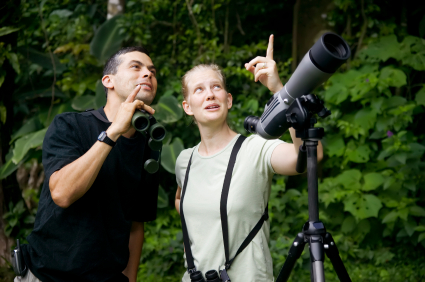
In conclusion, it must be evident that I had an inherent love of birds from the start as I had a great affinity for dinosaurs as child. Many scientists agree that birds are simply evolved dinosaurs, and perhaps that constant remained with me all the way into my adult years. Being out in nature and studying the diversity of the many different species of birds is unlike anything I have experienced. The activity itself has allowed me to open my eyes to my surroundings, constantly looking up in the sky or the trees and listening to the sounds. It is now a behavior of mine of which I hope I never let go.

 Patrick Meeker: Sustainability-focused Product Management and Digital Transformation
Leave a comment